CARALIS OS · Governed execution
Put the capabilities you already have to work.
Individuals, teams, and organizations achieve objectives through capabilities carried by human knowledge and skills, software, automation, and AI agents. CARALIS OS aims to help them identify, reuse, compose, extend, and govern executable capabilities across domains—so new objectives need not mean rebuilding everything from scratch.
Capability-centric · Domain-independent · Agent-neutral
From personal projects to complex operations.
Processing Elements and Pipelines are general execution abstractions—not limited to business processes or AI agents. They can express useful work in personal productivity, data processing, research, software, organizational operations, and other domains where executable contracts and appropriate controls can be defined. Existing agentic frameworks are welcome integration partners, not required dependencies.
Start with the objective
Reuse first. Compose and extend when needed.
When a person, team, or organization faces new work, the first question should be what it can already do. Existing capabilities may be reused, composed, or extended; missing capabilities can be acquired or developed. CARALIS OS is being designed to make executable capabilities explicit and governable, independent of whether they originate in conventional software, automation, or agentic frameworks.
Know your capabilities
Define purpose, ownership, inputs and outputs, dependencies, execution policies, and evidence of successful outcomes.
Make reuse economical
Reduce unnecessary rebuilding by improving integration and deployment repeatability. Evaluate discovery, integration, operation, and maintenance costs together.
Retain organizational authority
Execution policies belong to the organization and should not depend on a particular model or agentic framework.
Lower total cost is a design objective. Comparative savings have not yet been established through published benchmarks.
Designed for a distributed world
Bring your infrastructure. CARALIS OS provides the runtime.
CARALIS OS is designed to connect compatible, heterogeneous computing resources with independently managed Platforms and participating organizations. This is an operating model—not a diagram of our internal implementation.
The foundation
Operate anywhere. Build and reuse. Execute with governance.
Infrastructure on your terms
Deployment Units can combine compatible servers and computing resources that customers own or control. The goal is flexibility across suitable on-premises, hosted, and hybrid environments.
Multi-platform
A Deployment Unit can host independently managed CARALIS OS Platforms, each providing an environment for applications and executable capabilities.
Multi-tenant participation
Organizations participate as tenants. Identity and access controls establish who can use a Platform and which operations they are authorized to perform.
Versioned catalogs
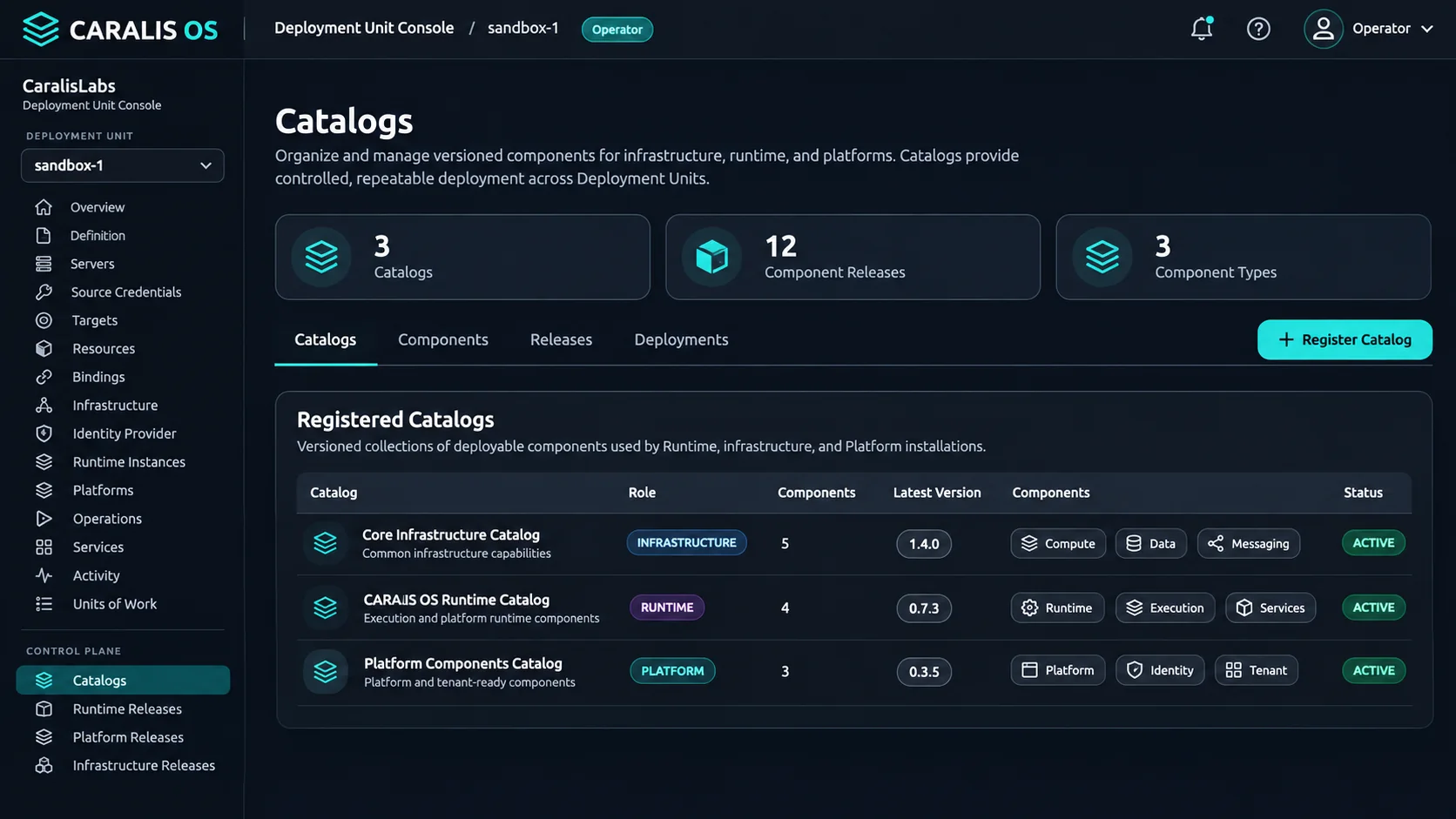
Structured catalogs organize infrastructure, Runtime, and Platform component releases, helping operators manage what is available for deployment.
Composable capabilities
Processing Elements perform reusable operations. PER pipelines compose them into executable processes that can support many different domains.
Governed operations
Operational controls and execution evidence support accountability throughout deployment and execution—not merely generating recommendations.
Separate intelligence from execution
Intelligence evolves. Your capabilities endure.
Models, applications, and agent frameworks will change. Useful executable work should not have to be rebuilt around each one. CARALIS OS is designed to keep Processing Elements and Pipelines independently defined, with execution coordinated through the Platform rather than delegated to an individual AI agent's harness.
Independently defined work
Processing Elements encapsulate operations; Pipelines compose them with explicit dependencies and inputs.
Execution authority stays separate
A request to perform work is not automatically permission to execute it. Applicable Platform controls govern execution.
Reusable across initiators
The same Pipeline definition is intended to serve supported human, application, and AI-assisted entry points.
This is an architectural design principle. Cross-framework interoperability and repeatable Sandbox-1 deployment remain under validation; external agent integrations are planned.
Learn why independent capabilities matter →Platforms · Federation direction
From infrastructure to accessible capabilities—and beyond.
Deployment Units provide the operational environment. Platforms bring capabilities and services together for authorized people and organizations. PER coordinates the execution of reusable work.
Our architectural direction extends this model through governed inter-Platform and inter-Deployment-Unit communication, laying the groundwork for federation while preserving the autonomy of participating environments.
Federation is a planned direction, not a currently available production capability.
Explore Platforms and federation →The execution foundation · PER
From Processing Elements to executable pipelines.
At the heart of CARALIS OS is the Pipeline Execution Runtime (PER), designed to coordinate reusable processing operations as structured, executable pipelines. Processing Elements provide individual operations; pipelines define their composition and dependencies; PER coordinates execution and exposes execution state and results.
Processing Elements
Reusable components that expose specific processing operations, such as computations, integrations, and data transformations.
Pipelines
Structured compositions of processing steps with explicit dependencies, execution context, and configurable mappings.
Pipeline Execution Runtime
The execution engine that coordinates pipeline runs and makes their progress, status, and outputs observable.
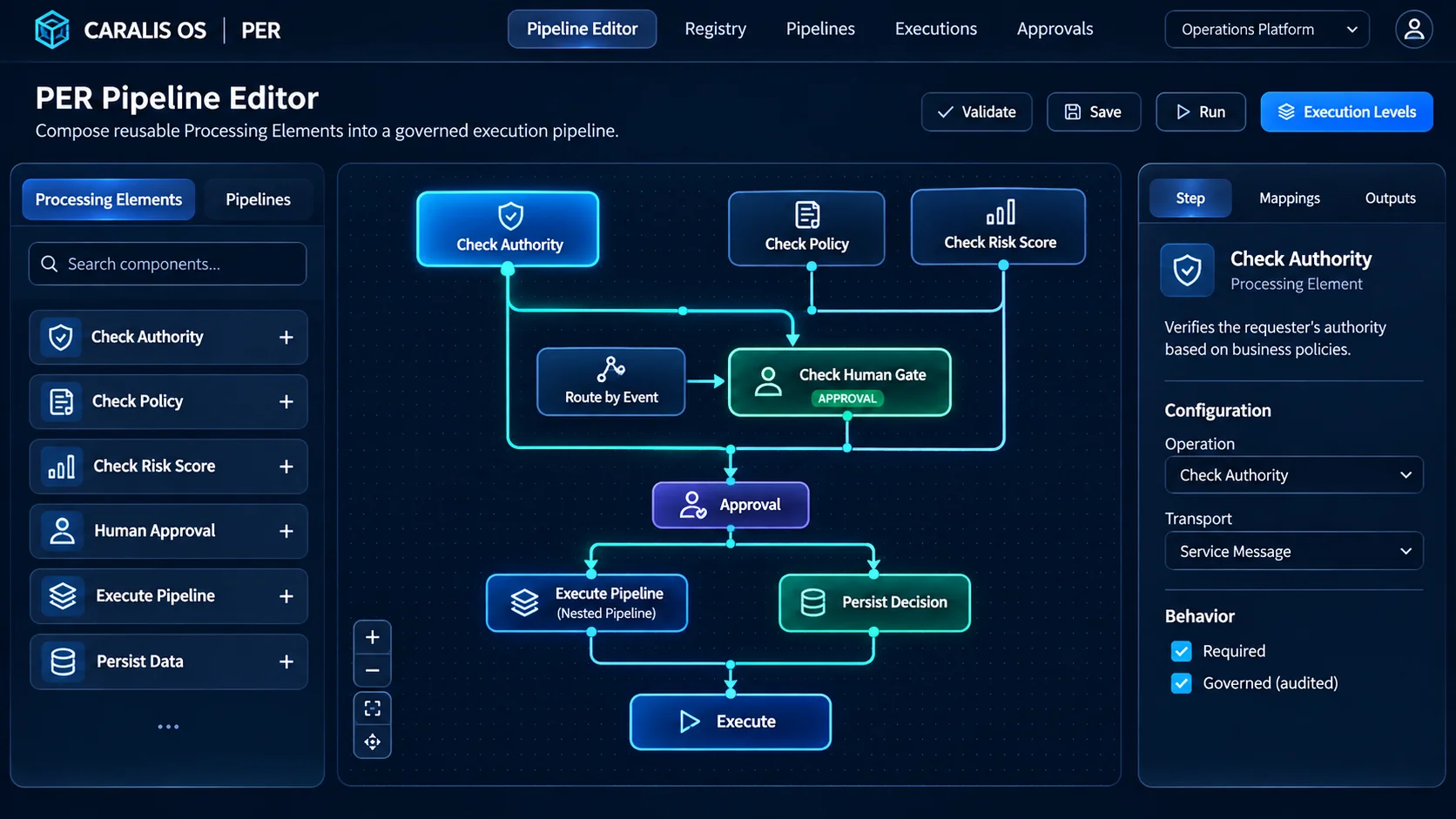
Illustrative interface based on PER development work; not a product screenshot.
Explore PER, pipelines, and Processing Elements →From knowledge to execution
Domain capabilities, not just business workflows.
A domain capability represents a useful operation in a particular field. It might be a single step or a coordinated process. CARALIS OS uses Processing Elements and PER pipelines as building blocks for reusable execution.
One execution foundation. Multiple domains.
Potential applications include business operations, software and data processing, scientific and engineering workflows, industrial automation, and robotics. Domain-specific integrations, real-time constraints, and safety requirements must be validated separately; these examples are directions, not claims of ready-made solutions.
Agentic integration · Direction
Keep your agents. Extend their capabilities.
CARALIS OS aims to complement existing agent frameworks in both directions: agents can use governed capabilities, and existing agents can become Processing Elements in PER pipelines.
Explore our agent-neutral approach →Integration roadmap · Planned
Bring your agents. Connect them to governed execution.
Already building AI agents? We're exploring interfaces that would let external applications discover and request domain capabilities while CARALIS OS governs execution.
Native capability interfaces and a Model Context Protocol (MCP) adapter are planned integrations, not currently available.
Explore agentic integration collaboration →Inside CARALIS OS
A look at the operating environment.
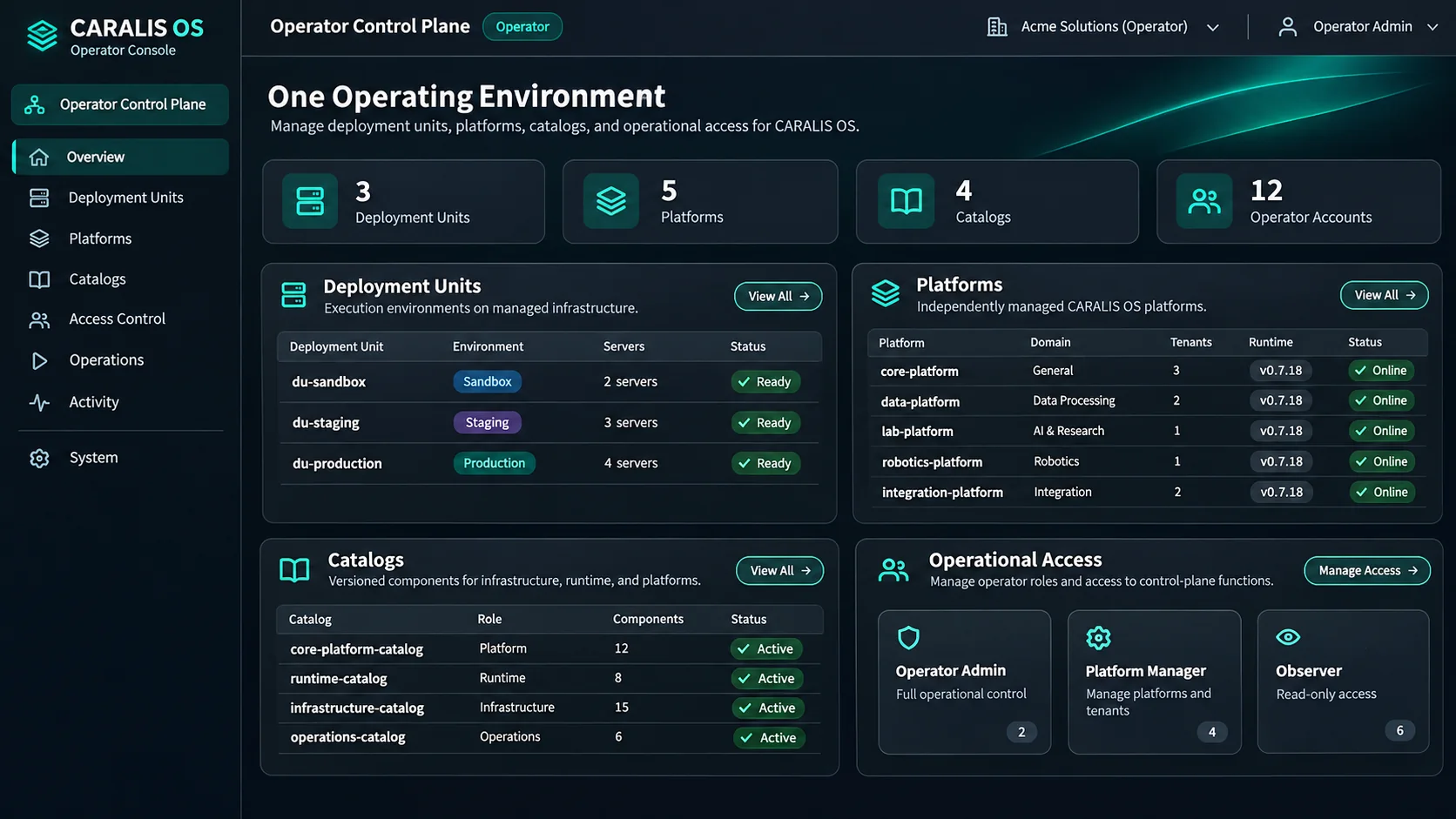
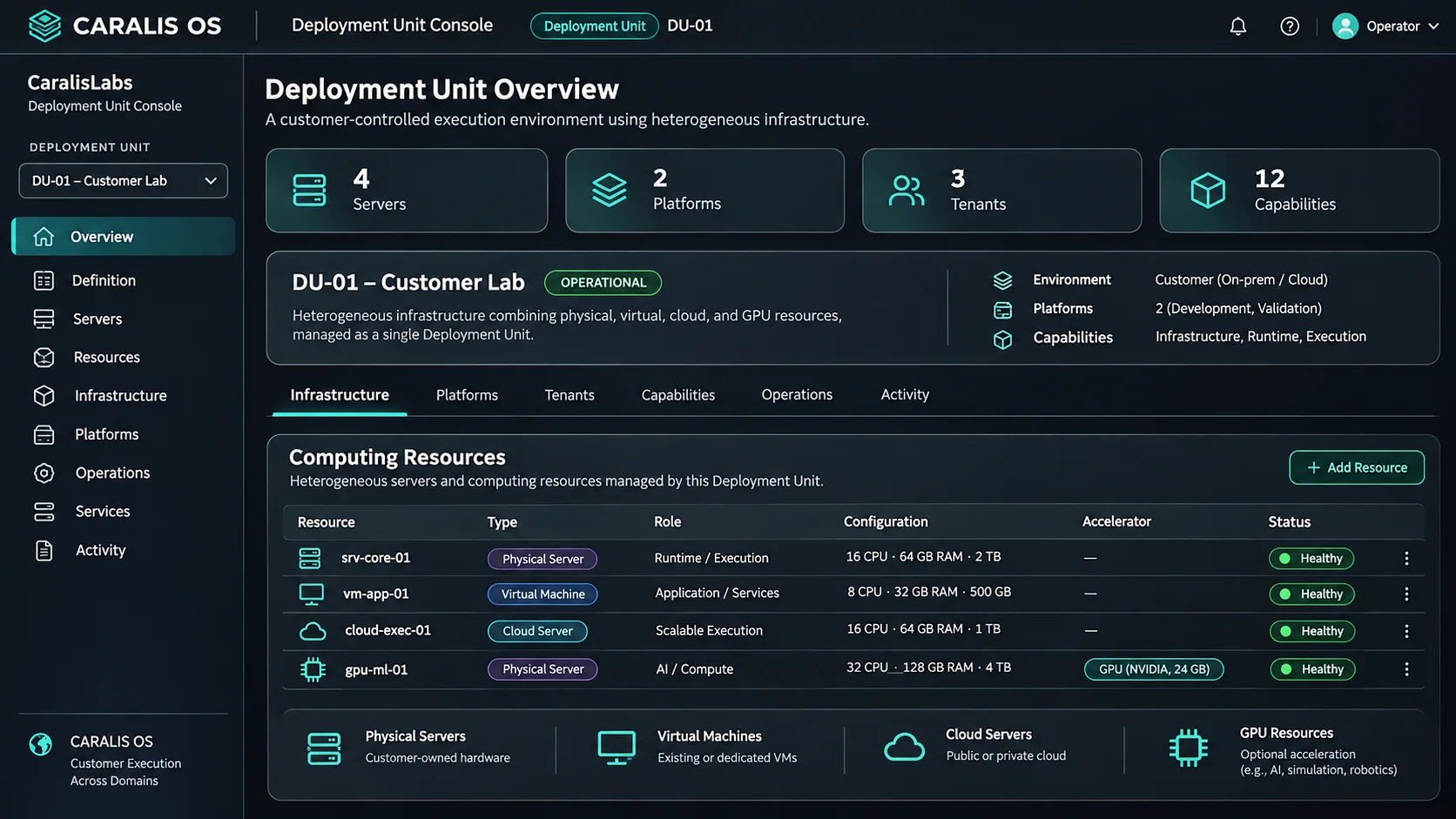
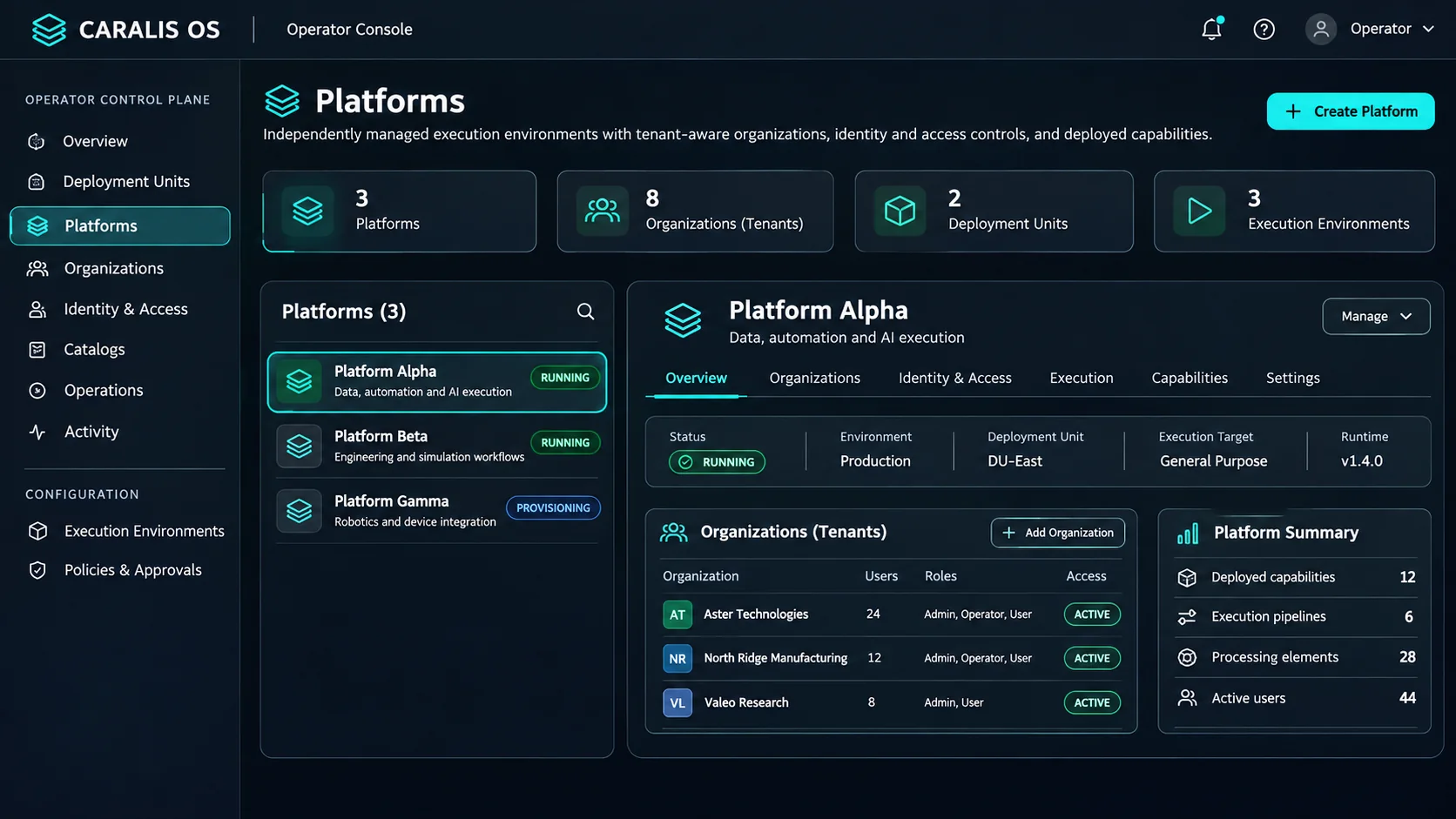
Explore how operators, infrastructure, Platforms, and catalogs come together in one governed execution environment.
Illustrative interface previews. These redesigned concepts use fictional data and may differ from current or future product interfaces. They do not represent verified deployment states.
Product in development
An operating environment taking shape.
CARALIS OS has operator and Deployment Unit interfaces for managing computing resources, catalogs, infrastructure, and Platform installations. Sandbox-1 deployment and end-to-end repeatability validation are ongoing.
Selected demonstrations and sanitized product views will be shared as workflows are verified. Infrastructure compatibility and deployment options depend on the relevant environment.
The Execution Economy
Build with us. Explore the value we can create.
We're inviting early customers, domain experts, developers, and business partners to explore opportunities around CARALIS OS. Bring a domain problem, specialized knowledge, technical expertise, or relationships—we'd like to understand what we could create together.
Collaboration and any potential revenue participation are subject to separate agreements. CaralisLabs retains ownership of its proprietary technology.
Explore CollaborationFrom business functionality to reliable operation
CARALIS OS is being developed to connect executable capabilities with the infrastructure and lifecycle operations that support them. An initial engagement may involve only the components appropriate to a verified customer need.
Explore small business solutions →CARALIS OS · DSTE
From desired state to governed execution
The Declarative State Transition Engine (DSTE) compares observed and desired states and determines necessary changes. It complements existing CARALIS OS operational capabilities.
Describe the objective, establish what exists, determine what needs to change, and execute through governed capabilities.
Live state-changing execution and recovery verification remain subsequent milestones.
Explore the milestone →